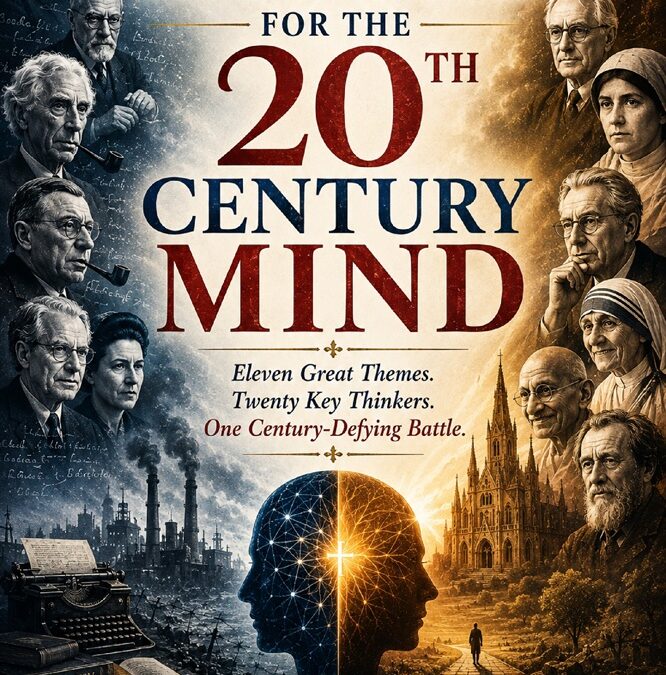
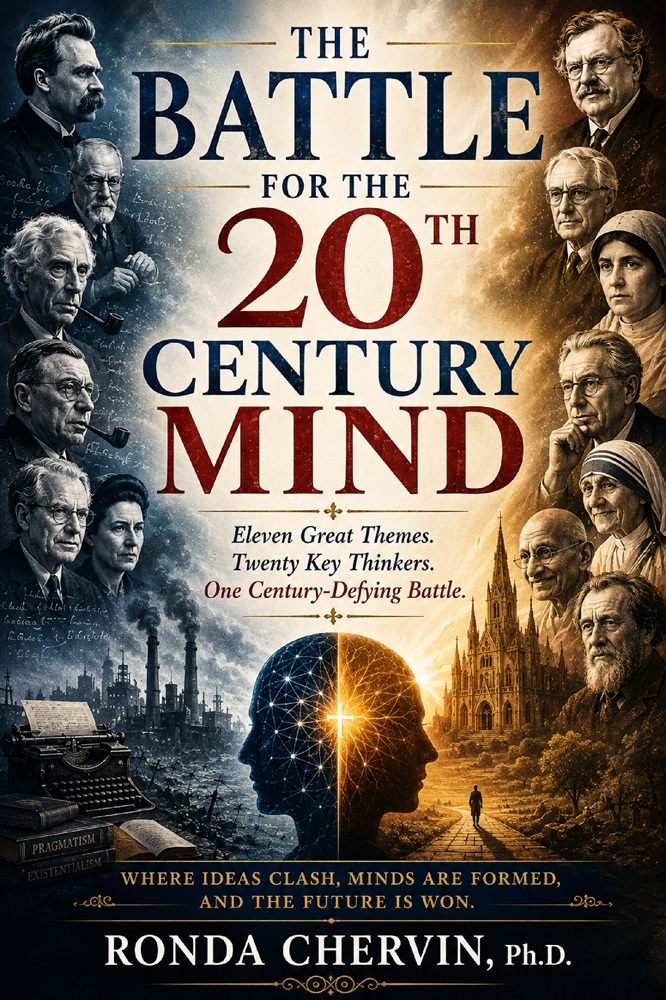
A review of Dr. Ronda Chervin’s, The Battle for the 20th Century Mind (St. Luis, MO: En Route Books and Media, 2022) by Francis Etheredge
Ronda Chervin sets out her course through the 20th Century as a dialogue between notable pairs and herself; however, on occasion there is more than a notable pair. Chervin begins the book with James Dewey (1842-1910) and William James (1842-1910) and ends it with Albert Camus (1913-1956) and C. S. Lewis, which makes it slightly out of sequence as she precedes these two with Sartre (1905-1980) and St. John Paul II. I not only like and admire the range of her “pairs” but appreciate, too, her plan to recover from her “opponents” what he or she has to offer. In this same style of pithy comment and argument Chervin proceeds promptly and at a reasonable pace through her period companions. Each person is introduced within the framework of a reasonably brief but apposite cameo and, as far as one can tell, a fair assessment, neither omitting nor exaggerating key facts and works. Furthermore, there are often a range of excerpts from the people under consideration and, therefore, Chervin’s book starts to serve the purpose of a reader, too: a book giving actual samples of a variety of works.
The book as a whole, we begin to realize, is not a strictly chronological account of thinkers through the 20th Century; rather, it is thematic, introducing us to a range of themes and thinkers, beginning with “Religion of Experience vs. Religion of Doctrine” and ending with “Evil as Proof of Atheism vs. God as the Answer to Suffering”. At the same time, Chervin provides a variety of resources to help the interested reader or actual student of philosophy, giving a mixture of primary and secondary sources. There is a particularly attractive set of excerpts from the work of St. Edith Stein which pertains very much to the present day need to understand the equality and complementarity of the sexes; and, in a different but equally exemplary way, there is the prolife work of Joan Andrews. In other words, this book easily suffices as an introduction to both the general reader and to the student who needs an overview of the background to contemporary thought.
While Chervin specifically recommends another of her books on ethics (cf. p. 116) there are excerpts and themes which apply, directly or indirectly to human nature and moral action; for instance, as regards those who want to permit euthanasia or even seek it, there is the work of Viktor Frankl, who ‘thought there were many layers where illness could arise, and that one of them was due to failure to find meaning in life’ (p. 100). Furthermore, there is a substantial treatment of the theme of freewill vs determinism with numerous excerpts from von Hildebrand.
In general, however, this book would work well with one of the many introductions to “perennial philosophy”, the philosophy that integrates truth with truth throughout the ages and constantly draws on reality as it exists, not confusing “what is the effect of the fall of man” with what in fact points to the enduring reality to be redeemed. At the same time, we could say, the book tends towards the possibility of a new synthesis, taking from each author what can be recognized as part of a renewed understanding of the nature of reality and the human person.

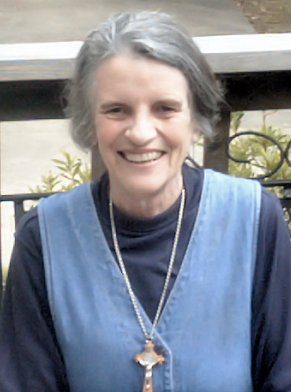 Ronda Chervin has a Ph.D. in philosophy from Fordham University and an M.A. in Religious Studies from Notre Dame Apostolic Institute. She is a convert to the Catholic faith from a Jewish but atheistic background. She has been a professor at Loyola Marymount University, St. John’s Seminary of the Los Angeles Archdiocese, Franciscan University of Steubenville, Our Lady of Corpus Christi, and Holy Apostles College and Seminary in Connecticut. Eighty-five books of hers have been published by Catholic presses in the area of philosophy and spirituality. Dr. Ronda presents on EWTN and Catholic radio. Her many books include



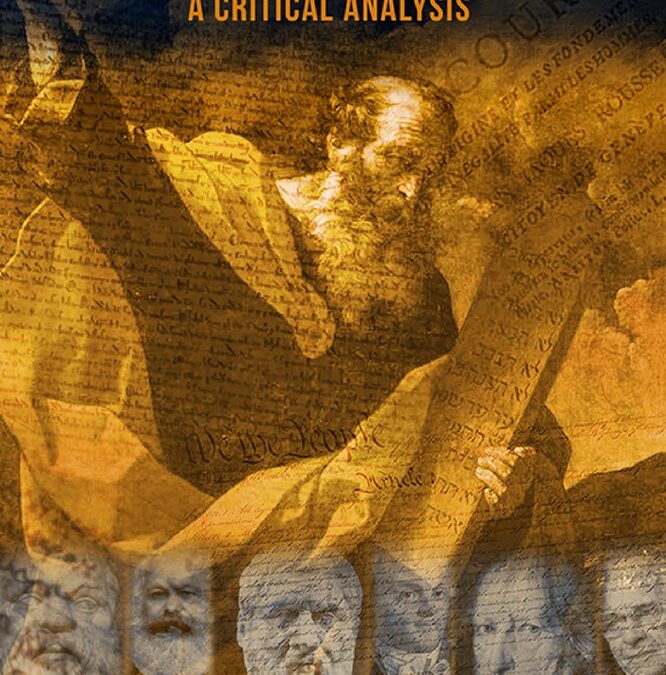
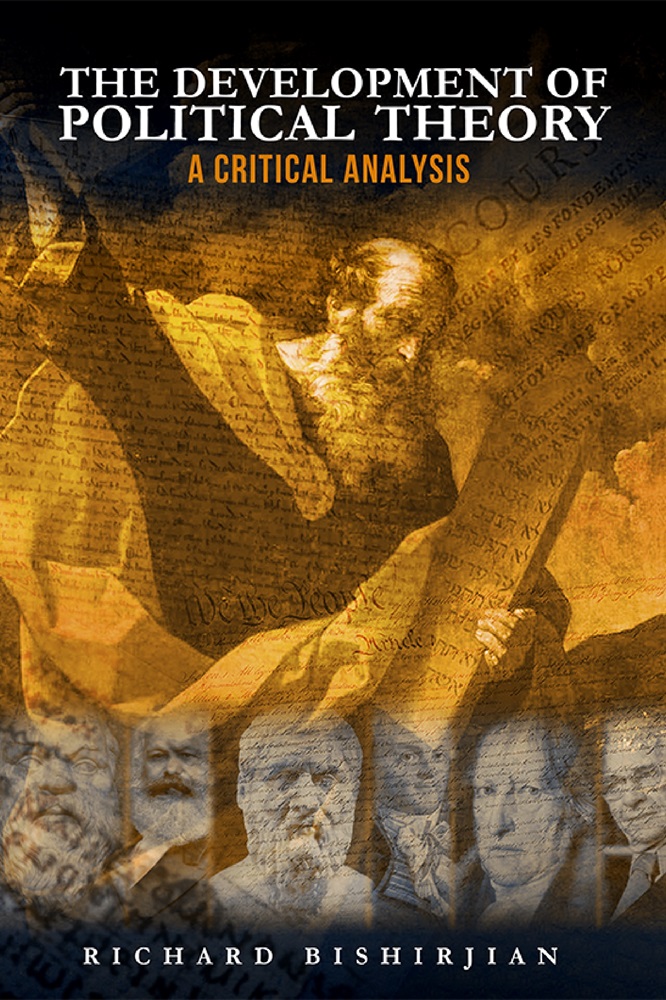
 Richard J. Bishirjian was Founding President and Professor of Government at Yorktown University from 2000-2016. He earned a B.A. from the University of Pittsburgh and a Ph.D. in Government and International Studies from the University of Notre Dame.
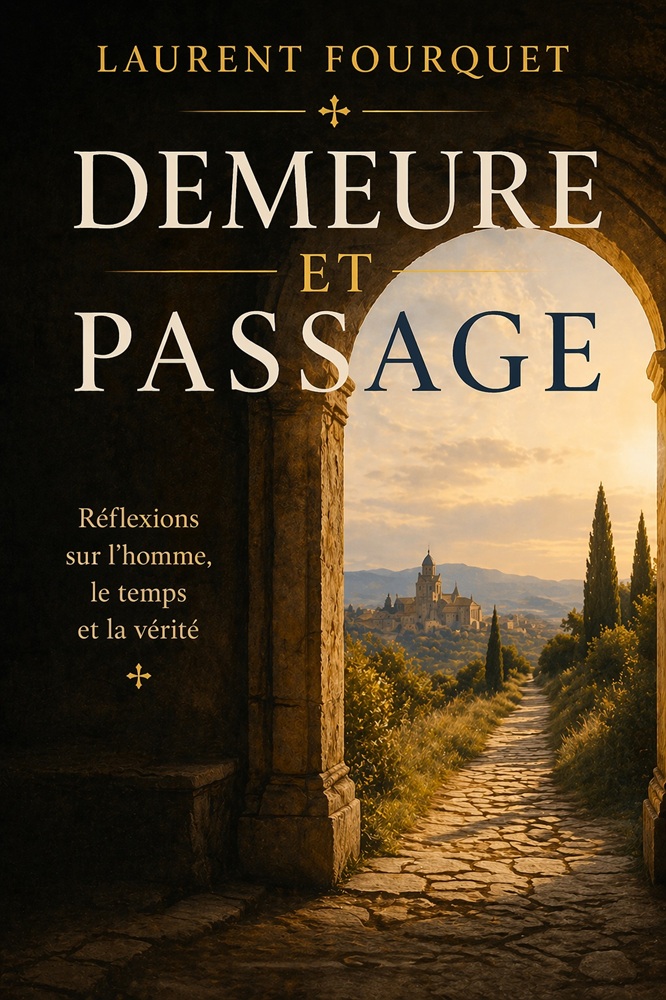
 Laurent Fourquet est haut fonctionnaire au ministère de l’Économie en France et a publié quatre ouvrages : L’ère du consommateur (2011), Le moment M4 – Une réflexion sur la théorie de la valeur en économie (2014), Le christianisme n’est pas un humanisme (2018) et Le raisin et les ronces (2020).
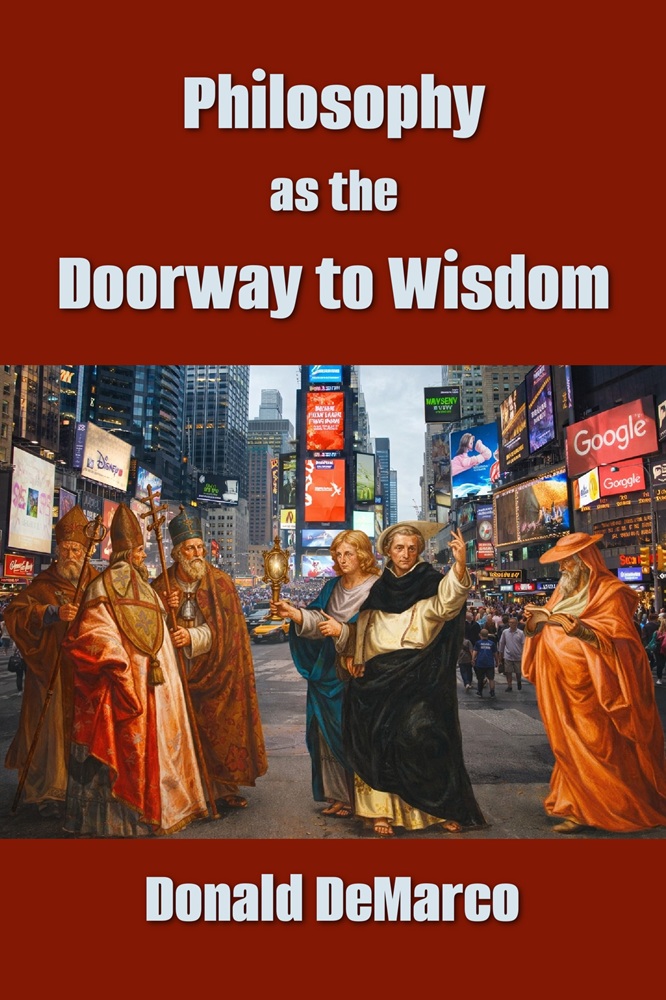
 Donald DeMarco, author of 48 books, including most recently,